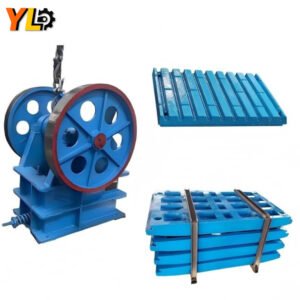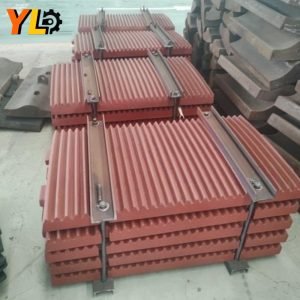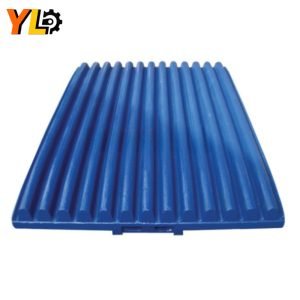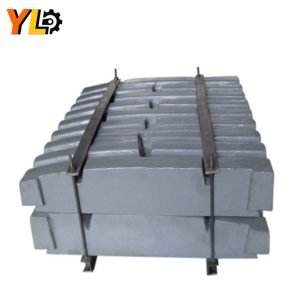
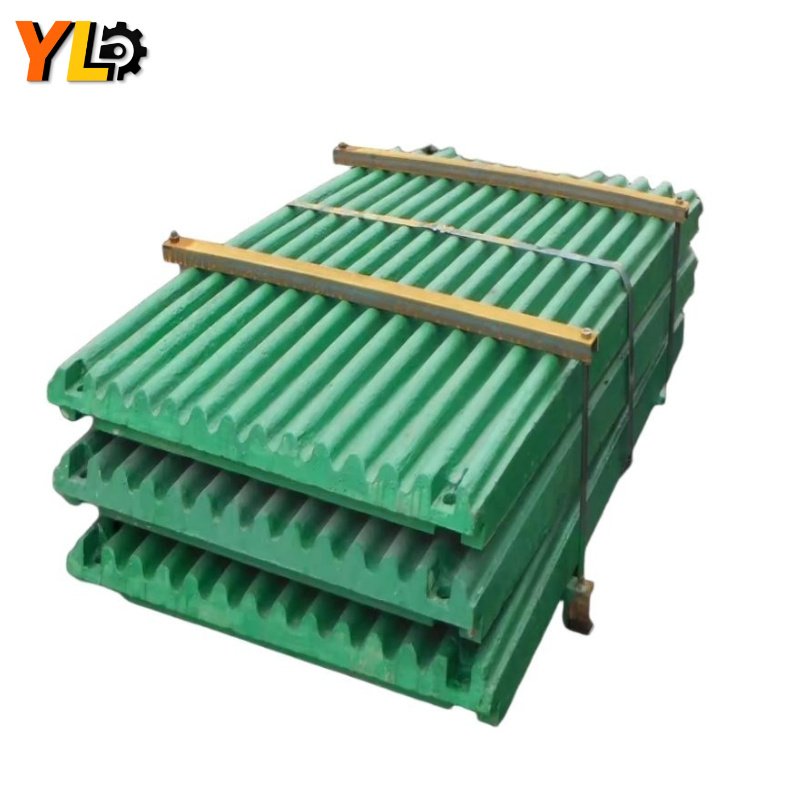
Jaw plates are the heart of every jaw crusher in the crushing and mining industry. These are the critical wear parts, mounted on the fixed and moving jaws and responsible for breaking down material and determining your crusher’s efficiency, throughput and operating costs. But there is one question that still dominates the conversations of quarry operators, mining engineers and maintenance managers: What is the best material for jaw plates?
As with most engineering decisions, the answer is nuanced. The optimal material for jaw plates should have a reasonable balance of wear resistance and toughness with the costs and should adapt to the specific operating conditions. This comprehensive guide covers the full range of jaw plate materials, from the traditional high manganese steel to the latest composites, with practical advice to help you optimize your crushing operations.
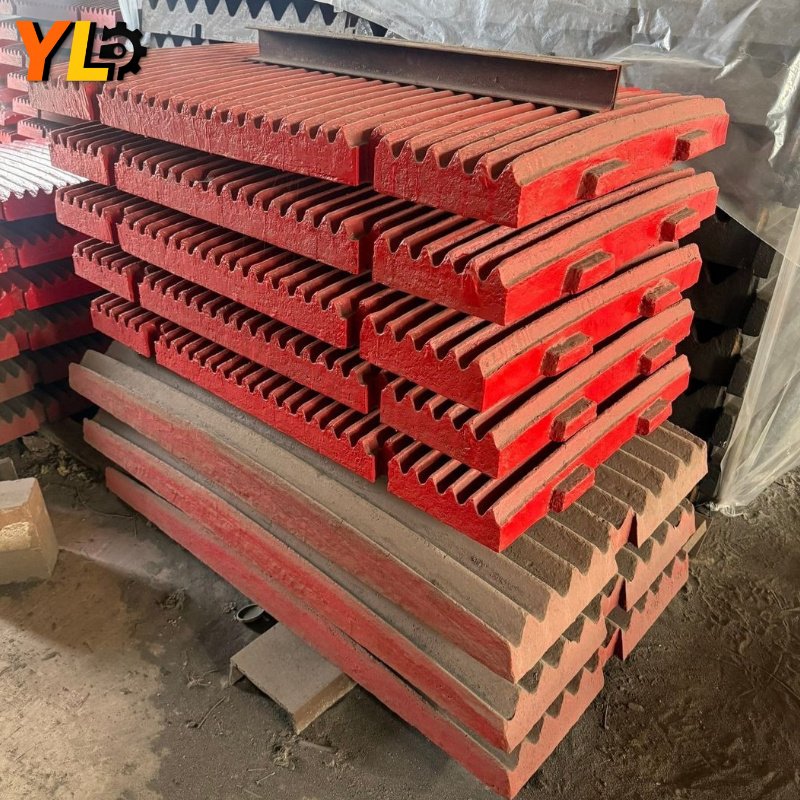
1. High Manganese Steel: The Industry Standard
The Work-Hardening Phenomenon
The industry standard for jaw plates is still High Manganese Steel (HMS) and that’s no accident. The main characteristic is its outstanding work hardening (strain hardening) ability: when subjected to a strong mechanical shock, the surface of the material hardens rapidly, while the core maintains excellent toughness.
The surface hardness of high manganese steel can be rapidly increased from about HB200 to HB450-550 under strong impact, to form an outer layer of high wear resistance. Some studies report hardening to HB500-600 under optimum conditions. This unique property makes HMS suitable for high impact primary crushing applications where impact forces are large.
Manganese Grades Compared
Not all manganese steels are created equal. The manganese content significantly influences performance:
The scientific studies have established a clear hierarchy. Steels 110Mn8 and 110Mn10 have low austenite stability, and steels 110Mn13 and 110Mn18 are metastable, i.e. they undergo controlled martensitic transformation as a consequence of deformation, which is crucial to their high wear resistance. For especially critical applications, 110Mn13 and 110Mn18 are classified as “especially critical purpose” materials.
Service Life Expectations
The manganese steel jaw plates performance is highly dependent upon the material being crushed. A typical Mn13Cr2 jaw plate may last 400 hours in limestone but break up in quartzite in less than 100 hours due to micro-cracking. For high-hardness granites and basalts, the usual manganese steel will give a service life of 300 to 500 hours.
This wide performance gap underscores a critical truth: material selection must be application-specific.
2. Wear-Resistant Alloy Steel: When Abrasion Dominates
For crushing operations dealing with highly abrasive materials—granite, iron ore, or high-silica content rocks—wear-resistant alloy steels offer compelling advantages.
Chromium-Molybdenum (Cr-Mo) Alloys
By adjusting chromium, molybdenum, and other alloy elements, manufacturers can increase matrix hardness to HRC50-55 while maintaining sufficient toughness through tempering treatment. When crushing granite and iron ore, Cr-Mo alloy jaw plates demonstrate 2-3 times higher wear resistance than standard manganese steel, with service life extending to 800-1200 hours.
High Chromium Cast Iron
High chromium cast iron (Cr15-Cr26) offers exceptional hardness, reaching HRC58-68—significantly harder than manganese steel. This translates to outstanding abrasion resistance, particularly valuable when processing high-hardness materials.
However, there is a trade-off: high chromium iron has relatively poor toughness and is prone to fracture under high impact loads. It is best suited for “low impact, high abrasion” steady-state operations such as fixed crushing stations.
Alloy Steel: The Versatile Alternative
Alloy steel jaw plates—incorporating chromium, molybdenum, nickel, and vanadium—offer higher hardness than manganese steel and superior resistance to fine particle abrasion. They excel in secondary and fine crushing applications where impact forces are lower but abrasion is persistent.
3. Advanced Materials: The Next Generation
Composite Materials
The industry is moving decisively beyond单一材料 solutions. Recent metallurgical developments have enabled the deployment of advanced alloys and composite materials that offer dramatically improved wear life.
One prominent European manufacturer recently unveiled a new generation jaw plate utilizing a martensitic steel matrix reinforced with ceramic particles—a combination that demonstrated a 40% increase in service life in abrasive granite and basalt crushing applications.
Ceramic composite jaw plates represent another frontier: a metal matrix (typically high manganese or high chrome steel) provides structural integrity and shock absorption, while ceramic reinforcements deliver extreme wear resistance at critical contact points.
Titanium Carbide (TiC) Reinforced Plates
Some manufacturers are now producing jaw plates with titanium carbide alloy cast using solid solution strengthening technology. TiC-reinforced plates place tungsten carbide inserts in critical impact zones, dramatically extending service life where wear is most concentrated.
Ceramic-Enhanced Solutions
For operations with high-silica content materials, ceramic-enhanced jaw plates can reduce wear by up to 45%. These advanced materials are increasingly accessible as manufacturing technologies mature and costs decrease.
4. Tooth Profile Design: The Material-Design Synergy
Material selection alone does not determine performance. Tooth profile design works in concert with material properties to optimize crushing efficiency.
The Impact of Tooth Height
Research has demonstrated that tooth height differences (0-10mm) significantly influence crushing outcomes. Increasing tooth height difference from 0mm to 10mm can improve the yield of target-sized ore (-40+25mm) from 37.16% to 64.03%, while increasing production capacity by 30%.
Profile Selection Guide
The appropriate tooth shape increases contact area between material and jaw plate, improves the crushing ratio, and reduces the load on downstream processes.
5. How to Choose the Right Jaw Plate Material
Step 1: Analyze Your Feed Material
The starting point for jaw plate selection is understanding your material:
- Soft or non-abrasive materials (limestone, coal): Lower-grade manganese (Mn13) or smooth profiles
- Hard, abrasive rocks (granite, basalt, quartz): Higher manganese content (Mn18-Mn22) with aggressive tooth profiles
- High-silica content operations: Ceramic-enhanced or composite materials
- Recycling and demolition: Bimetallic or reinforced heavy-duty plates
Step 2: Balance Hardness and Toughness
The key to wear resistance lies in balancing hardness (resisting compression and micro-chisel damage) with toughness (preventing edge chipping and impact fatigue). No single material excels in both—the optimal choice depends on your dominant wear mechanism.
Step 3: Consider Total Cost of Ownership
The cheapest jaw plate is rarely the most economical. Choosing the right plates can increase crushing efficiency by 25-40% while reducing replacement costs. Consider:
- Service life (tons crushed per set)
- Downtime costs (frequency of changeouts)
- Energy consumption (worn plates increase energy use by 15-25%)
- Maintenance labor
Step 4: Verify Precision Fitment
Poorly fitting replacement plates can lead to structural movement, accelerated localized wear, and potential damage to the main crusher frame. Always ensure your supplier uses advanced measurement techniques (e.g., 3D scanning) to guarantee OEM-level tolerance.
6. Smart Technology: The Future of Jaw Plate Management
AI-Powered Wear Prediction
The integration of artificial intelligence is transforming how we manage jaw plate wear. By analyzing thousands of historical operating data points, AI systems can predict the wear trajectory of specific rock materials on the plate surface.
A DEM-driven machine learning framework now enables accurate, real-time wear prediction, facilitating predictive maintenance and optimized design. This intelligent approach extends service life while significantly reducing maintenance costs.
Sensor-Embedded Plates
Several manufacturers are embedding ultra-high frequency RFID tags or sensors directly within jaw plates. These sensors enable real-time monitoring of wear levels from the plant’s control system, allowing for:
- Predictive maintenance scheduling
- Optimal replacement timing (maximizing usable life without risking failure)
- Transition from reactive to proactive maintenance
Selecting the right jaw plate material is not a one-size-fits-all decision. It requires a deep understanding of your specific application, feed material characteristics, crusher configuration, and operational goals.
At Yinglin Mining Casting, we combine decades of metallurgical expertise with cutting-edge manufacturing capabilities to deliver jaw plates optimized for your unique crushing environment. Whether you need:
- Standard Mn13/Mn18 high manganese steel for general quarry applications
- Cr-Mo alloy steel for high-abrasion operations
- Advanced composite materials for extreme conditions
- Custom tooth profiles tailored to your feed and output requirements
We have the solution.
Keywords: crusher jaw plates, jaw plate materials, high manganese steel, Mn13, Mn18, Mn18Cr2, alloy steel jaw plates, composite jaw plates, wear-resistant parts, mining wear parts, jaw crusher parts, Yinglin Mining Casting